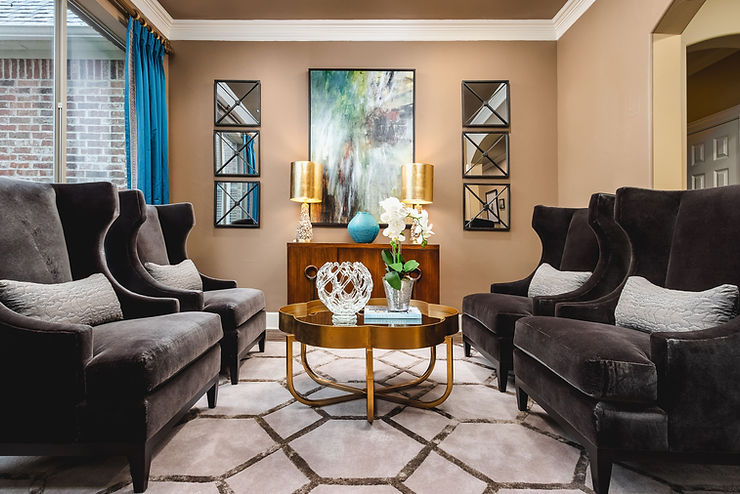
How Does Custom Drapery Improve Interior Design?
Custom drapery improves interior design by adding softness, proportion, color, texture, privacy, and light control while visually connecting a room’s furnishings and architectural features. Unlike standard curtains, custom drapery is designed specifically for the window and surrounding space, allowing the fabric, length, fullness, lining, hardware, and placement to support the overall interior design.
At hōme•ol•o•gy, we believe window treatments should feel like an intentional part of a room rather than something added after the design is complete. Custom drapery gives us the opportunity to consider the architecture, furnishings, color palette, natural light, and way a client actually uses the space. Every decision, from fabric weight and pleat style to mounting height and hardware, can influence the finished result. Our approach combines thoughtful design with personalized service, helping homeowners create interiors that are polished, comfortable, and distinctly their own. When drapery is planned as part of the complete design, it can transform both the appearance and experience of a room.
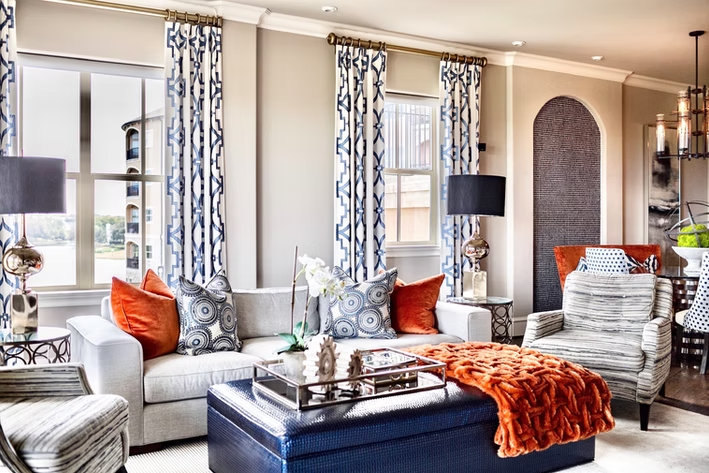
Benefits of Custom Window Treatments for a Finished Interior
Custom window treatments offer an advantage that ready-made curtains cannot easily replicate: they are designed around the exact proportions and needs of the space.
Houzz’s 2026 guide to choosing window treatments notes that designers consider more than privacy and light control. Window treatments can become a design focal point, complement a home’s architectural style, or serve as a subtle supporting element. Houzz also notes that designers frequently layer shades and blinds with drapery, beginning with the functional needs of the room before addressing aesthetics.
That combination of beauty and function is what makes custom drapery such a valuable interior design tool.
Why Does Custom Drapery Look Better Than Ready-Made Curtains?
Custom drapery often looks more polished because its dimensions, fullness, fabric, and construction are tailored to the individual window and room.
Ready-made panels typically come in predetermined widths and lengths. That can create compromises, especially with tall ceilings, oversized windows, unusual architectural features, or rooms where precise proportions matter.
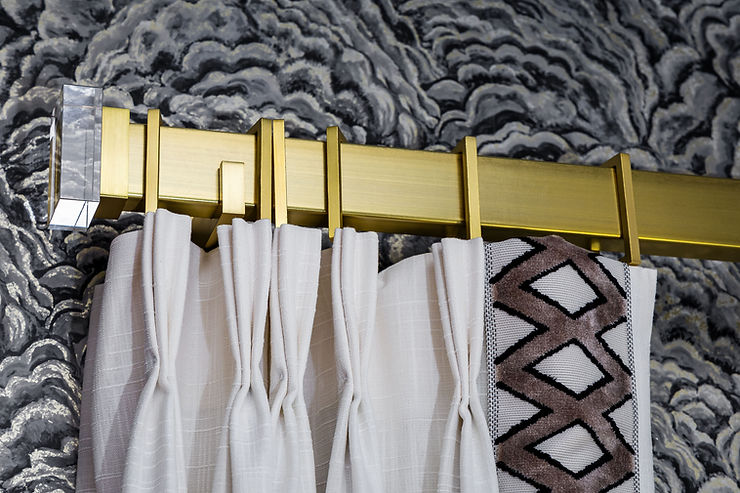
With custom drapery, designers can control details such as:
- Finished length and width
- Fabric fullness
- Pleat or header style
- Lining and interlining
- Pattern placement and matching
- Decorative trim
- Rods, rings, tracks, and other hardware
- Mounting height and width
- Stationary versus functional panels
- Manual or motorized operation
Proportion is particularly important. Houzz’s guide to custom drapery explains that taller and wider windows often require greater fabric volume to achieve an appropriately substantial appearance. Too little fabric can make drapery look thin compared with the scale of the window.
The goal is not simply to cover the glass. It is to make the treatment feel architecturally appropriate for the entire room.
How Can Drapery Change the Look and Feel of a Room?
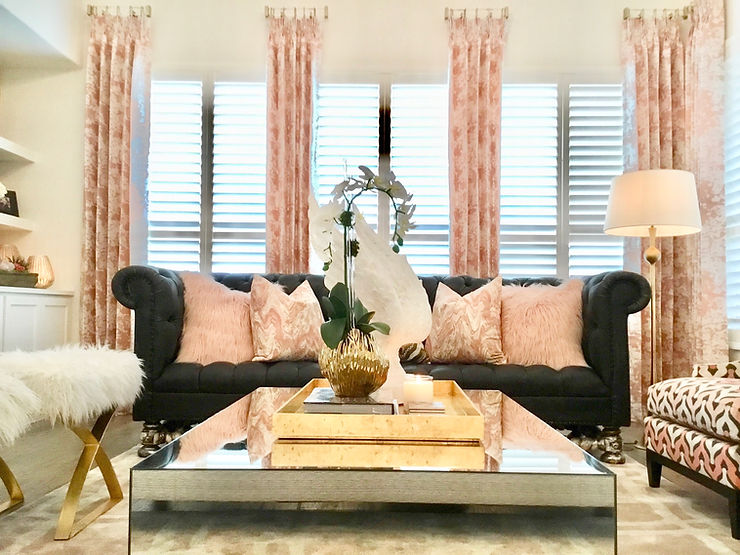
Drapery can visually soften architecture, emphasize ceiling height, introduce texture, and make a room feel warmer and more complete.
Fabric creates a contrast with the hard materials commonly found throughout a home, including wood, glass, stone, metal, tile, and cabinetry. That softness can be especially valuable in living rooms, bedrooms, dining rooms, and other spaces where comfort is part of the desired atmosphere.
Mounting placement can also change how the architecture is perceived. Drapery installed higher than the top of the window can draw the eye upward and emphasize vertical space. Extending the treatment beyond the window frame can make the window appear more substantial while providing space for panels to stack when open.
Fabric selection adds another layer of design opportunity. Linen can create a relaxed, organic feeling, while velvet can introduce richness and visual weight. Sheers can diffuse natural light, and patterned fabrics can repeat colors or motifs found elsewhere in the room.
According to Houzz, curtains and drapes are an important part of a room’s design because their wide range of fabrics, patterns, colors, and hardware allows them to make a significant visual statement while adding softness, dimension, and texture.
Does Custom Drapery Improve Privacy and Light Control?
Yes. Custom drapery can provide precise levels of privacy and light control because the fabric, lining, dimensions, and layering strategy can be selected for the room’s specific needs.
A bedroom, for example, may benefit from lined or blackout drapery, while a living area may need softer light filtration. A room that requires daytime privacy without sacrificing natural light might use sheer panels combined with another window treatment.
Designers can also layer drapery with:
- Roman shades
- Roller or solar shades
- Woven shades
- Blinds
- Shutters
- Sheers
Layering provides greater flexibility because each treatment can serve a different purpose. Houzz’s current window treatment guidance notes that designers often combine shades or blinds with drapery to balance function, privacy, light, and appearance.
Custom construction can further improve coverage. Properly designed returns and overlaps can reduce gaps at the sides and center of closed drapery, which can be particularly important when privacy or room darkening is a priority.
Can Custom Drapery Help With Comfort and Energy Efficiency?
Window treatments can contribute to indoor comfort by helping manage sunlight and heat transfer, although their performance depends on the fabric, construction, installation, window, and climate.
The U.S. Department of Energy emphasizes that windows have an important influence on building energy performance and indoor comfort. It also notes that strategies such as interior shades and blinds can help reduce unwanted solar heat gain. Window performance is especially important because the appropriate solution varies with climate, orientation, glazing, and other factors.
For custom drapery, designers can consider:
- Heavier fabrics for additional insulation
- Linings or interlinings
- Blackout linings for bedrooms and media spaces
- Layered window treatments
- Wider coverage to minimize gaps
- Fabrics suited to the room’s level of sunlight
These functional considerations can be incorporated without sacrificing the design. Instead of choosing between a beautiful window and a practical one, custom treatments allow both priorities to be addressed together.
How Do You Choose the Right Custom Drapery for Your Interior?
Start with the function of the room, then choose a treatment that complements its architecture, scale, palette, and furnishings.
A professional designer will typically consider several questions:
- How much privacy is needed? Bedrooms and bathrooms may require more coverage than living or entertaining spaces.
- How should natural light behave? Decide whether you want to filter, soften, block, or maximize daylight.
- Should the drapery stand out or blend in? A bold fabric can become a focal point, while a tonal fabric can add subtle texture.
- What proportions suit the architecture? Window size, ceiling height, wall space, and nearby furnishings all influence placement and fullness.
- How will the drapery operate? Stationary panels can frame a window decoratively, while functional drapery must be designed to open and close smoothly.
- Does another window treatment need to be layered underneath? Combining drapery with shades or blinds can provide greater flexibility.
Hardware should also be considered early. Decorative rods can become part of the room’s visual language, while streamlined tracks may nearly disappear into the architecture. Motorized systems can be especially useful for tall, wide, or difficult-to-reach windows.
When every element is selected together, custom drapery becomes part of the room’s architecture rather than an accessory competing with it.
Frequently Asked Questions About Custom Drapery
Is custom drapery worth the investment?
Custom drapery can be worthwhile when fit, fabric quality, proportion, function, and design cohesion are priorities. It is particularly valuable for large or unusually proportioned windows and spaces where standard curtain sizes do not create the desired finished appearance.
Should curtains touch the floor?
Floor-length drapery typically looks most intentional when it finishes at or very near the floor, although some designs intentionally allow fabric to break or puddle. The correct length depends on the desired style, fabric, and how frequently the panels will be opened and closed.
Should drapery match the wall color?
Drapery does not need to match the walls. Tonal fabrics can create a calm, seamless look, while contrasting colors or patterns can make the windows a focal point. The best choice should support the room’s complete color and material palette.
Are custom drapes better than blinds or shades?
Neither is universally better because they serve different purposes. Drapery excels at adding softness, scale, texture, and visual impact, while blinds and shades can provide precise privacy and light control. Layering the two can offer the benefits of both.
Complete Your Interior With Custom Drapery
Windows occupy a significant amount of visual space, which means their treatment can influence the entire room. Custom drapery allows those windows to become an intentional part of the design through carefully considered fabric, proportion, construction, hardware, privacy, and light control.
At hōme•ol•o•gy, we look at window treatments in the context of the entire interior. The right drapery can soften architectural lines, highlight ceiling height, introduce beautiful texture, frame a view, improve privacy, and provide the final layer that makes a room feel thoughtfully complete.
Ready to transform your windows into an integral part of your interior design? Contact hōme•ol•o•gy today to explore custom drapery and window treatments designed specifically for your home.